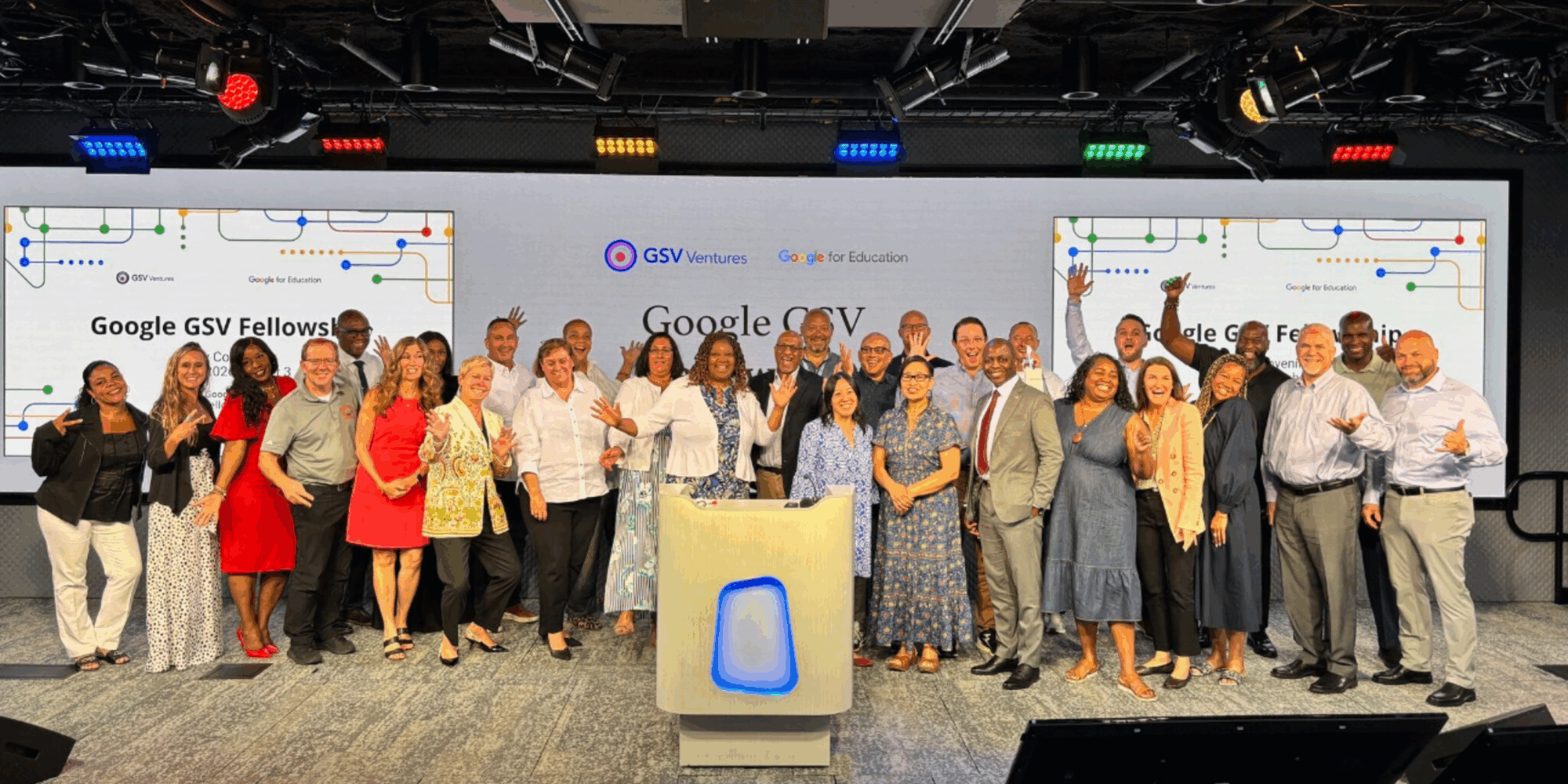
This summer, I had the privilege of joining a group of bold education leaders from across the country as a part of Google’s Education Innovation Fellowship. It’s an experience that’s already shaping how I think about the future of learning—not just at E.L. Haynes, but across public education more broadly.
Over the past several weeks, I’ve had the chance to meet with E.L. Haynes staff, students, and families across all three campuses. What’s been most striking is the shared sense of care—for our young people, for one another, and for deepening the work already in motion across our classrooms and campuses.
That energy is what I carried into my first meeting as a member of Cohort 3 of the collaboration between Google Education and GSV. We gathered at Google’s Chicago headquarters to explore questions like:
How can we accelerate student success?
And what bold ideas are worth building now?
As part of the experience, each fellow is developing a solution to a real challenge from their school system. At E.L. Haynes, that challenge is designing school for the full range of learners—not just for students who fit the default mold.
One early idea I brought into the Fellowship is something we’re calling Eli—an AI-powered learning tool designed to help students understand their learner profile, develop strategies to become more independent, and get unstuck in moments where support might be missing.
This fall, we’ll launch design teams with teachers and students to test, challenge, and reshape the idea from the ground up. Eli may evolve—or it may spark a better idea entirely. That’s the point. Innovation shouldn’t be done to schools—it should be built with them.
While at Google, I explored tools like Gemini for Education and NotebookLM, and began imagining how they might power that kind of support. We also looked inward—at the traps that derail change—during a powerful session with Susan Asiyanbi, founder of The Olori Network. She reminded us that having a big vision isn’t enough. Without alignment, even good ideas can fall apart—and our students can’t afford that.
We were also given a clear charge:
If we don’t get on the innovation train,
we will get left behind—and so will our students.
E.L. Haynes has a history of innovation—from the early work that helped launch LearnZillion to its long-standing commitment to equity. Now it’s time to write the next chapter. One that keeps inclusion at the center and meets the needs of all types of learners—because our students are complex, and so is their brilliance.
We’ll share our progress at ASU+GSV this spring, where our work will stand alongside other breakthrough models from across the country. I’m proud to represent Haynes there—and even more excited to build what’s next with our community.
Written by Toni R. Barton | Toni R. Barton serves as the Chief Executive Officer of E.L. Haynes Public Charter School. A longtime advocate for equity and inclusion, she brings over two decades of experience leading schools and systems to design learning environments where all students thrive. Read her full bio.